1. Serving
Serving is the only skill in volleyball where you have complete control over the ball. There is no teammate helping you and no defense reacting yet — it is just you and the ball. A well-placed serve can immediately put the other team on their heels and set the tone for the entire rally. The three main types of serves are the underhand serve, the float serve, and the jump serve.
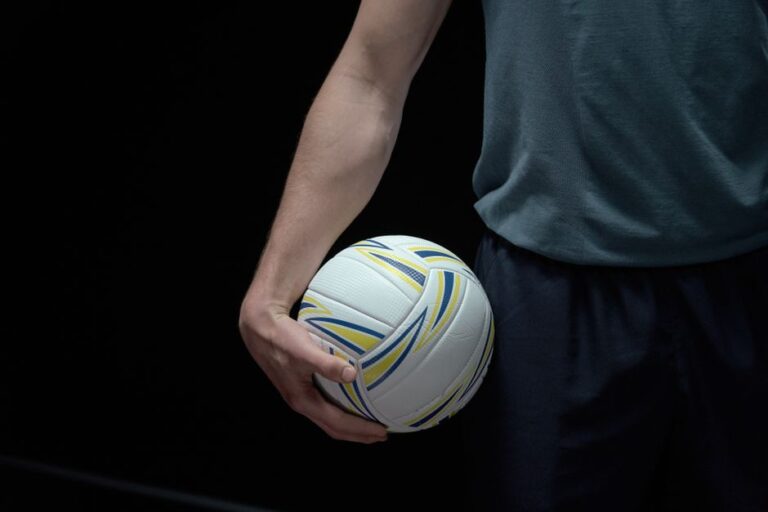
The underhand serve is where most beginners start. It uses a simple motion: hold the ball in front of your hip, swing your dominant arm back, and make contact with a closed fist. It is easy to control but lacks power. The float serve is the next step up. Contact the ball with a short, sharp motion using an open hand. The key is to hit through the center of the ball with no spin. A good float serve will move unpredictably in the air, making it hard for passers to read. The jump serve is the most advanced option. You toss the ball high, take a three-step approach, jump, and contact the ball at the peak of your jump. This generates maximum power but requires consistent timing and practice.
Practice tip: stand 10 feet from the net and serve 50 balls aiming for the opposite sideline. Track how many land in bounds. Move back 5 feet and repeat. Consistency before power is the key.
2. Passing
Passing, also called the forearm bump, is the foundation of every rally. Without a clean pass, your setter cannot run the offense and your team cannot attack effectively. Good passing starts with footwork. Get your body behind the ball early. Your arms should be straight and locked at the elbows, with your hands together and thumbs pointing down.
Contact the ball on the fleshy part of your forearms, not your wrists. Angle your platform toward your target — ideally your setter’s hands. The lower body does most of the work. Bend at your knees, not your waist, and absorb the ball’s energy by relaxing your shoulders on contact. A common mistake is swinging your arms. Instead, let the ball bounce off a firm, steady platform.
Practice tip: pass against a wall from 10 feet away. Aim for the same spot every time. Do 3 sets of 20 repetitions. Focus on keeping your platform level and your feet moving.
3. Setting
Setting is the most technically demanding skill in volleyball. The setter touches the ball on nearly every play, making this role critical to a team success. Good setters use soft hands, proper footwork, and quick decision-making.
The key to a clean set is hand position. Form a triangle with your thumbs and index fingers above your forehead. Your thumbs should point toward your eyes. As the ball arrives, extend your arms and push with your fingertips. The release should be smooth and high — about 3 feet above the net for a standard outside set. Your feet must get you to the ball before your hands do. If you are off-balance, your set will be inaccurate regardless of how good your hands are.
Practice tip: set against a wall from 5 feet away. Set 50 balls aiming for the same spot. Then move to 10 feet. Focus on clean contact and consistent height.
4. Attacking
Attacking, or hitting, is how you score points. The approach matters more than arm strength. For right-handed hitters, the footwork is left-right-left. Start with your weight on your right foot, take a long first step with your left, then a quick right-left plant. Swing both arms back as you take your first step, then drive them forward as you jump.
Your arm swing should be high and fast. Pull your hitting elbow back, rotate your hips, and snap your wrist at the peak of your jump. Aim for the deep corners or the seams between defenders. Reading the block is a skill itself — if the block is early, hit around it. If it is late, hit over it.
5. Blocking
Blocking is your first line of defense at the net. A good block takes away the hitter options and makes the defender job easier. Read the hitter approach angle and jump after they leave the ground. Press your hands over the net with your fingers spread wide and firm. Angle your hands inward to deflect the ball back into the court. Footwork is critical — shuffle quickly along the net to get in position.
6. Digging
Digging is defensive positioning against hard-driven attacks. Stay low in an athletic stance with your weight on your toes. Watch the hitter shoulder and arm speed to predict the shot. React to the ball and keep it off the floor. The best defenders read plays before they happen.
7. Serving Receive
Serving receive requires quick reactions and a controlled platform. Watch the server hand contact point to read the type of serve. Move your feet early and communicate with teammates by calling “mine” or “short.” Take charge of your zone.
8. Transition
Transition is the split-second movement from defense to offense. After digging or blocking, you must immediately turn and get into attacking position. Quick footwork and court awareness are essential. Most points at higher levels are scored in transition, not in serve-receive offense.
9. Court Awareness
Knowing where you are on the court, where your teammates are positioned, and what the opponent is doing is a skill that separates good players from great ones. Study the game constantly. Watch the hitter, the setter, and the defense all at once. The more you see, the faster you react.
10. Communication
Volleyball is a team sport, and communication is the glue that holds everything together. Call for every ball, call out the rotation, and encourage your teammates. Use short commands like “mine,” “help,” “free,” and “out.” Teams that talk to each other play with more confidence and fewer errors.
Final Thoughts
Mastering these core volleyball skills takes time and consistent practice. Pick one or two skills to focus on each week. Ask your coach for feedback, record your drills, and track your progress. The players who put in the work on fundamentals are the ones who make the biggest impact when it matters most.
Get 1 Mental Training Drill Every Week
Free. Unsubscribe anytime.
VBallStars.com
Mental Training for Volleyball
Published by VBallStars.com — founded by a former college athlete and volleyball dad who spent nearly a decade in the gyms, watching his daughter come up through top clubs from North Texas to Atlanta, GA, and noticed the mental side was the last thing coached, if at all. Read the full story →