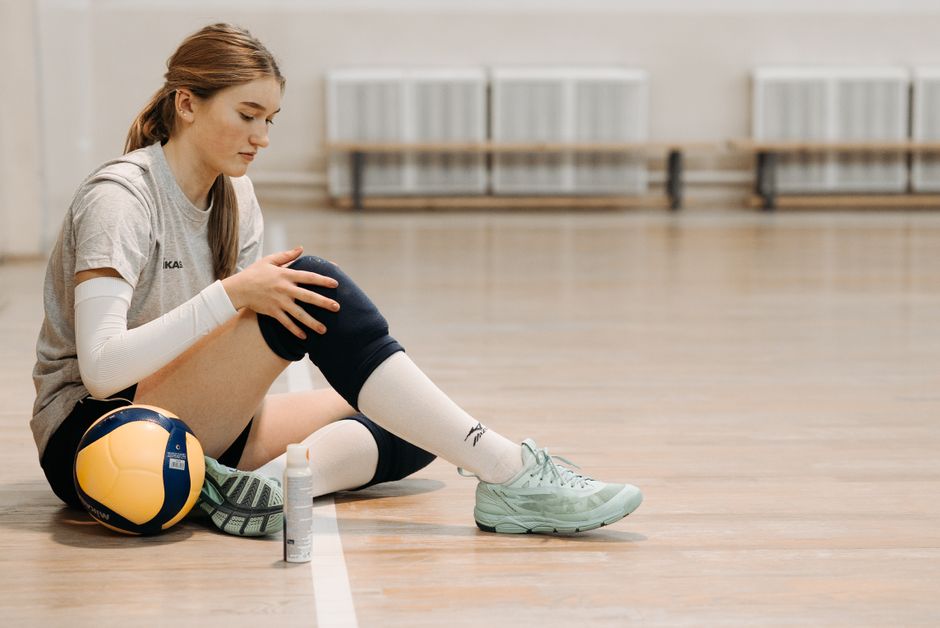
You are at practice two hours a day, five days a week, and half your defensive reps end with your knees on a hardwood floor. A dig here, a sprawl there, a pancake that saves the point. Every one of them sends impact straight into the front of your knee.
That is the job of a knee pad in volleyball: standing between your kneecap and the floor, rep after rep. Here is how to choose a pair that fits, protects, and holds up through a full club season, plus the honest truth about what knee pads can and cannot do for your long-term knee health and injury recovery planning.
Why Do Volleyball Players Need Knee Pads?
Volleyball is one of the few sports where hitting the floor is part of good technique. Defensive moves like digs, rolls, and sprawls put the knee directly on a hard surface, dozens of times per session. Reviews of volleyball injuries list knee problems among the most common complaints in the sport, alongside ankle sprains .
Knee pads address the impact side of that equation. They cushion the kneecap against floor contact and prevent the bruises, scrapes, and swelling that come with defensive play. For liberos and defensive specialists, pads are basically standard equipment.
One honest distinction matters here. Knee pads protect against impact. They do not prevent overuse conditions like jumper’s knee, also called patellar tendinopathy, which develops from repeated jumping and landing loads rather than floor contact. Research on volleyball players has tied tendinopathy risk to landing mechanics under fatigue, such as stiffer, straighter landings late in sessions . Coaches screen for that risk with jump-landing tests, and prospective studies track it with measurement scales built for the sport . Pad selection and jump-load management are two separate conversations.
Do Knee Pads Prevent Jumper’s Knee?
No, and any product that claims otherwise is overselling. Jumper’s knee comes from the tendon absorbing load from hundreds of jumps, not from hitting the floor . Studies of collegiate volleyball players find patellar tendinopathy even in athletes who wear pads every day, because pads do not change what happens in the air .
What actually helps: managing jump volume, training softer landings with more hip flexion, especially when tired, and building leg strength in the off-season . Pads protect the front of the knee from the floor. Training protects the tendon from the jump.
Which Type of Knee Pad Is Right for You?
| Type | Padding level | Best for | Price tier | Common examples |
|---|---|---|---|---|
| Full-sleeve pad with dense front padding | High | Liberos, defensive specialists, hard courts | Mid | Mizuno LR6, ASICS Slider |
| Compression sleeve with thin padding | Low to medium | Setters and hitters who hit the floor less, players who hate bulk | Budget | Nike Essential, ASICS low-profile |
| Long knee pad with extended coverage | High | Growing players, anyone with a history of floor burns and scrapes | Mid | Mizuno long sleeve styles |
| Dual-sleeve layering (thin sleeve plus pad) | Adjustable | Players fine-tuning fit and coverage | Budget to mid | Any thin sleeve under any pad |
The tradeoff is always protection versus mobility. More padding protects the knee but adds bulk behind the knee when you run and jump. Less padding feels faster but leaves more bruising after long weekends.
What Should You Look For in Volleyball Knee Pads?
Five fit rules:
- Padding sits on the kneecap when you bend. Squat while wearing the pad. The padding must stay centered on the knee through the full bend, not ride up the thigh.
- Check the back of the knee. Bunching behind the knee causes chafing by match three. Look for flat or mesh-backed construction.
- Size by measurement, not guesswork. Brands size by knee circumference. Between sizes, size down. Sleeves stretch out over a season, never back in.
- Match the sleeve to the laundry plan. Pads soak up sweat and hold odor. Check care labels. Washable, quick-dry fabrics survive a club season.
- Bring your socks and shoes when you test. The pad’s hem should not fight your sock line. Sliding hems are a distraction you do not need.
Which Knee Pad Models Do Volleyball Players Use Most?
These are the models you see most often in high school and club gyms. We cannot test products in a lab, so treat this as a shortlist by style, then check current prices and recent reviews before you buy.
- Mizuno LR6. The classic defensive pad. Dense front padding with a snug sleeve. Common choice for liberos.
- ASICS Slider. A volleyball-brand staple with a lower profile than the Mizuno, popular with players who want protection without bulk.
- Nike Essential. The lightweight option for hitters and setters who mostly want floor protection at practice.
- McDavid hex-pad styles. Hexagonal padding that flexes with the knee. A common pick for multi-sport athletes.
- Under Armour volleyball sleeves. Compression-first fit with moderate padding for players who prioritize feel.
Pick by style first, then fit. A correctly sized budget pad beats a premium pad sliding down your leg.
How Do You Break In and Care For Knee Pads?
Wear new pads for a full practice before using them in a match. The sleeve molds to your leg after two or three sessions. Wash them after every tournament weekend and let them air dry. Heat drying breaks down the padding foam. Rotate two pairs across a club season if you practice more than four days a week, and replace any pad where the front cushion has flattened.
FAQ: Volleyball Knee Pads
Do all volleyball positions need knee pads? Liberos and defensive specialists need them most. Front-row players who rarely sprawl can use lighter padding. Most players regret going without at least a thin sleeve.
Do knee pads prevent jumper’s knee? No. Jumper’s knee is an overuse condition from jump-landing load, not floor contact . Pads protect the kneecap from impact, while landing mechanics and load management protect the tendon.
How tight should volleyball knee pads be? Snug enough to stay in place through a full defensive drill without pinching. Numbness or deep marks on your skin means the sleeve is too small.
How long do volleyball knee pads last? One to two club seasons with normal use. Replace pads when the front cushion flattens, the sleeve loses stretch, or the padding shifts off the kneecap.
Can you wear two knee pads at once? Some players layer a thin sleeve under a pad for extra cushioning. Test fit first, because doubling up adds bulk behind the knee and can restrict movement.
Protect the Knee. Train the Mind.
Pads handle the floor. Your training handles the jump. And your focus handles everything else. Take the free mental performance assessment to see where your concentration and composure stand, and build the full game plan that keeps you on the court.
—
Sources
- Reeser JC, et al. “Strategies for the prevention of volleyball related injuries.” Br J Sports Med, 2006. PMID 16799111. https://pubmed.ncbi.nlm.nih.gov/16799111/
- Vermeulen S, et al. “Decreased Hip Flexion during Spike Jump-Landings after Fatigue is Predictive of Patellar Tendinopathy in Volleyball.” J Athl Train, 2025. PMID 40235178. https://pubmed.ncbi.nlm.nih.gov/40235178/
- MacDonald K, et al. “Jumper’s Knee: A Prospective Evaluation of Risk Factors in Volleyball Players Using a Novel Measure of Injury.” Clin J Sport Med, 2020. PMID 30346313. https://pubmed.ncbi.nlm.nih.gov/30346313/
- Keefer Hutchison M, et al. “Low prevalence of patellar tendon abnormality and low incidence of patellar tendinopathy in female collegiate volleyball players.” Res Sports Med, 2020. PMID 31663370. https://pubmed.ncbi.nlm.nih.gov/31663370/
Get 1 Mental Training Drill Every Week
Free. Unsubscribe anytime.
VBallStars.com
Mental Training for Volleyball
Published by VBallStars.com — founded by a former college athlete and volleyball dad who spent nearly a decade in the gyms, watching his daughter come up through top clubs from North Texas to Atlanta, GA, and noticed the mental side was the last thing coached, if at all. Read the full story →