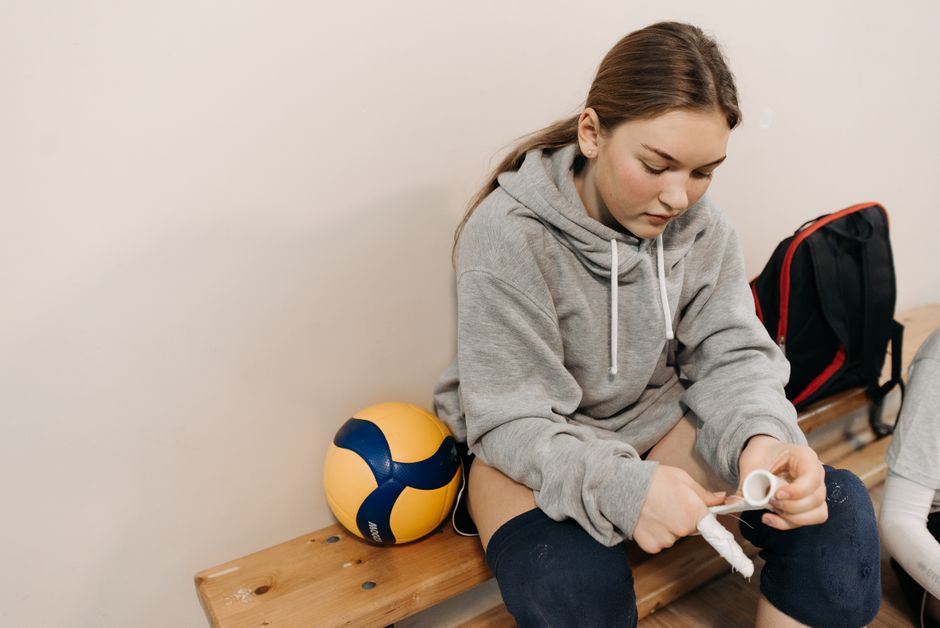
A club volleyball player’s bag is a small warehouse. Shoes for the court, flip-flops for between matches, a ball for warm-ups, knee pads, tape, snacks, a water bottle, and a hoodie for the six-hour wait between match blocks.
The right bag keeps all of that organized and off the gym floor. The wrong bag buries your kneepads at the bottom and dumps half its weight onto one shoulder. Here is how to pick a volleyball backpack that fits your gear, your position, and your body, including the load limits that matter for young athletes carrying school bags all day before practice.
Why Does the Bag Matter at All?
Two reasons: organization and load.
Organization is game-day logistics. Warm-ups are short. You need shoes, tape, and a water bottle without digging. A bag with the right compartments turns a scramble into a 30-second grab.
Load is a health question. Youth volleyball players often carry a school backpack all day and then add a gear bag for practice. A systematic review of school backpack research found most studies recommend limiting backpack loads to roughly 10 percent of body weight and warn that heavier loads change posture and add strain in children and teens . A narrative review of loads between 10 and 25 percent of body weight documented negative effects, while noting the overall evidence quality has real limits . Recent work continues to link heavy school bags to changes in gait and foot structure in growing kids .
The takeaway: gear bags count toward the same shoulders that carry school bags. Weight and fit matter more than colorways.
Which Type of Volleyball Bag Is Right for You?
| Type | Capacity | Best for | Price tier |
|---|---|---|---|
| Volleyball backpack (shoe base, ball pocket) | 30-40 L | Club players who carry gear daily | Mid |
| Duffel bag | 40-60 L | Multi-day tournaments, heavy packers, parents hauling team gear | Budget to mid |
| Backpack-duffel hybrid | 50 L+ | Two-day events with both straps and handles | Mid |
| Drawstring sack | 15-20 L | Practice-only loads, young players with light gear | Budget |
| Team rolling cart | Varies | Coaches and clubs moving balls and equipment | Premium |
For most club players, the volleyball-specific backpack wins: it carries a ball, isolates dirty shoes, and fits in a locker.
What Should You Look For in a Volleyball Backpack?
- A vented shoe compartment. Court shoes go in their own space, ideally on the base. Everything in the main pocket stays clean.
- A dedicated ball pocket. A full-size ball adds bulk. If the bag cannot hold one, you are carrying it loose through an airport-style facility hallway.
- A wet pocket for laundry. Knee pads and practice shirts get gross. A lined, wipeable pocket keeps them away from clean clothes and electronics.
- Two straps, always. Sling-style single-strap bags look good and load one shoulder. Given what the backpack research shows about asymmetric loads in young athletes, two straps is the safe default .
- A water bottle holder outside the main pocket. Condensation and spills belong away from clothes and phones.
- Reinforced zippers. Overloaded bags kill cheap zippers by mid-season. Larger teeth and fabric pulls survive club travel.
Which Volleyball Backpacks Do Players Use Most?
We cannot test products in a lab, so treat this as the shortlist you see in club gyms, then check current prices and recent reviews before buying.
- Mizuno volleyball backpacks. The club-volleyball default, built around a shoe base and a ball sleeve. Sized for daily club use.
- ASICS volleyball bags. Similar layout with a strong volleyball pedigree, often with cleaner interior organization.
- Under Armour and Nike team backpacks. The multi-sport route: durable, widely sized, less volleyball-specific storage but easy to find on sale.
- Adidas squad duffels. The roomy hybrid route for players who also haul gear for other sports.
Pick by layout first. The brand name matters less than whether the shoe base actually swallows your shoes.
How Heavy Is Too Heavy for a Volleyball Bag?
The backpack research gives a useful anchor: roughly 10 percent of body weight is the commonly recommended limit for school-age carries, with heavier loads linked to postural changes and discomfort . A 100-pound 13-year-old carrying a 15-pound bag is above that line before a single knee pad goes in.
Three habits keep the weight sane:
- Repack between events. Permanent-residence junk is the hidden weight in most bags.
- Wear both straps and tighten them. A snug, centered load beats a loose, swinging one .
- Split loads when you can. A small cinch sack for practice days and the full backpack only for tournaments.
FAQ: Volleyball Backpacks
What size volleyball backpack do I need? Daily practice loads fit in a 30 to 40 liter volleyball backpack with a ball pocket. Multi-day tournaments call for a duffel or hybrid.
Do volleyball players need a ball pocket? If your club requires you to bring a warm-up ball, yes. It is the difference between a bag built for volleyball and a school bag with a ball stuffed in the top.
Can a volleyball backpack work as a school bag? It can, but watch the combined weight. The research on youth loads points to roughly 10 percent of body weight as the common recommendation .
Are rolling bags allowed in volleyball facilities? Usually yes, but rolling bags are a coach and equipment-room tool more than a player one. Check your club’s bench policy before showing up with one.
How do I stop my bag from smelling? The wet pocket, plus air-out routines for knee pads and shoes, plus regular laundering of the bag’s removable panels. Never zip wet gear closed overnight.
Pack the Bag. Train the Mind.
Your bag carries your gear. Your preparation carries your game. Take the free mental performance assessment and check whether your mental equipment is as organized as your backpack.
—
Sources
- Janakiraman B, et al. “Reported influences of backpack loads on postural deviation among school children: A systematic review.” J Educ Health Promot, 2017. PMID 28584840. https://pubmed.ncbi.nlm.nih.gov/28584840/
- Perrone M, et al. “The Impact of Backpack Loads on School Children: A Critical Narrative Review.” Int J Environ Res Public Health, 2018. PMID 30424517. https://pubmed.ncbi.nlm.nih.gov/30424517/
- Lizis S, et al. “Effect of School Backpack Weight on Shape of Children’s Feet.” Med Sci Monit, 2026. PMID 41933886. https://pubmed.ncbi.nlm.nih.gov/41933886/
- D’Addio G, et al. “[Effects of the school backpack on walking kinematics: a mechanical overload potentially causing musculoskeletal disorders in developmental age?]” G Ital Med Lav Ergon, 2020. PMID 33119981. https://pubmed.ncbi.nlm.nih.gov/33119981/
Get 1 Mental Training Drill Every Week
Free. Unsubscribe anytime.
VBallStars.com
Mental Training for Volleyball
Published by VBallStars.com — founded by a former college athlete and volleyball dad who spent nearly a decade in the gyms, watching his daughter come up through top clubs from North Texas to Atlanta, GA, and noticed the mental side was the last thing coached, if at all. Read the full story →