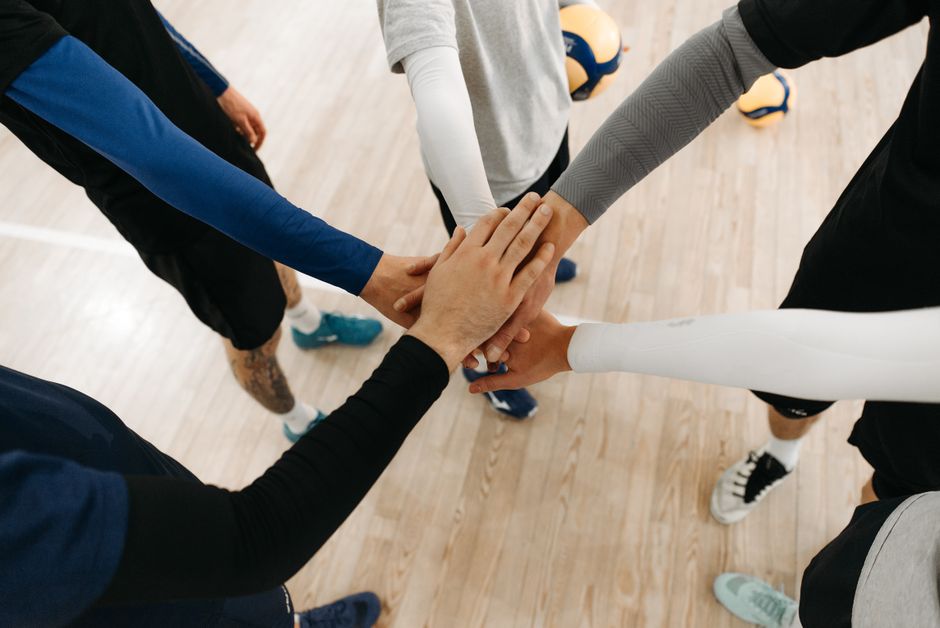
It happens the same way almost every time. The set goes up. You plant at the net. You come down on the outside of your foot, sometimes on an opponent’s shoe under the net, sometimes on a teammate’s heel. Your ankle rolls, the gym goes quiet, and your season changes in half a second.
Ankle sprains are the most common acute injury in volleyball . A brace will not make you invincible. It can help you finish a season on your feet, and if you have already sprained an ankle once, a brace becomes part of a bigger plan that includes smart recovery work and a comeback mindset.
Why Do Volleyball Players Sprain Ankles So Often?
The net is the reason. Volleyball concentrates its ankle risk in one spot on the court. Blockers and hitters jump and land in traffic, close to the line, with other bodies under them. Reviews of volleyball injuries point to landing at the net as the main ankle sprain mechanism, especially for front-row players .
Middle blockers carry the classic risk profile. They jump the most, land in the most crowded space, and do it hundreds of times a tournament weekend. Add hard courts, fast changes of direction, and packed 10-foot lines, and the ankle takes more unexpected load than almost any other joint. Studies across high school, club, and international play consistently rank ankle sprains at or near the top of acute volleyball injuries .
Do Ankle Braces Actually Prevent Sprains?
Braces help most after a first sprain, and they work best as one layer of a smart plan, not a substitute for training.
The strongest published evidence is for balance and proprioceptive work. In a controlled trial with volleyball players, a balance board program reduced ankle sprain risk in players who had sprained an ankle before . A school-based neuromuscular training program showed similar protective patterns for knee and ankle injuries in young athletes . Reviews of volleyball injury prevention recommend combining technique, landing drills, balance training, and external support such as a brace or tape for players with a sprain history .
The practical translation:
- No sprain history: train balance and landing skills first. A brace is optional.
- One or more sprains: brace the ankle and add balance work. That is the standard play.
- Coming back from injury: follow your trainer’s return-to-play plan and use the support level they recommend.
Which Type of Ankle Brace Is Right for You?
Match the brace type to your position and injury history. There are three main families, plus tape.
| Type | Support level | Best for | Price tier | Common models |
|---|---|---|---|---|
| Rigid hinged brace (hard shell, straps) | High | Net players, moderate or severe sprain history, return to play | Premium | Active Ankle T2, SuperBracket, Zamst A2-DX |
| Lace-up stabilizer (lace pattern plus straps) | Medium | All-around training, mild sprain history, smaller budgets | Budget to mid | McDavid 195, ASICS lace-up |
| Sleeve with figure straps (neoprene) | Low to medium | Minor soreness, players who want maximum feel | Budget | Shock Doctor sleeve styles |
| Athletic tape | Trainer-adjustable | Maximum freedom, highest maintenance | Ongoing cost | Applied by a trainer |
Front-row players who jump at the net usually choose rigid hinged braces for both-sides support. Setters and liberos often prefer lace-ups or low-profile hinges because footwork comes first. Youth players with growing feet should prioritize fit over maximum support.
What Should You Look For in a Volleyball Ankle Brace?
Five fit rules matter more than brand names.
- Low profile. If the brace makes your shoe unwearable, you will stop wearing it. Test the brace with your actual court shoes before committing.
- Both-side support at the net. Inversion sprains, the classic volleyball roll, happen outward. A brace that blocks both inward and outward roll fits the sport’s actual injury pattern.
- Size by shoe size, not generic letters. Sizing charts vary by brand. A brace that is one size too big slides. One size too small cuts circulation by the third set.
- Straps that survive a match. Look for straps you can retighten between sets without removing the shoe. Velcro loses grip over a season; check it monthly.
- Breathability for tournament days. Neoprene holds heat. If you play multi-match weekends, mesh panels or perforated shells keep the brace bearable.
Which Brace Models Do Volleyball Players Use Most?
These are the models you see most in high school and club gyms. We cannot test products in a lab, so treat this as a starting shortlist by type, then check current prices and recent reviews before you buy.
- Active Ankle T2. The classic volleyball hinge. A hard shell with a hinge that lets the ankle flex while blocking the roll. Common for middle blockers and hitters.
- Active Ankle SuperBracket. The lighter, lower-profile version used at higher levels. Popular with players who hate the feel of bulk.
- McDavid 195. The budget lace-up standard. Washable, cheap to replace, and easy to fit under any shoe.
- ASICS lace-up and stirrup styles. The volleyball brand option. Fits true to ASICS shoe sizing, which simplifies ordering.
- Shock Doctor sleeves with straps. A middle ground when a full hinge feels like too much.
- Zamst A2-DX. The premium hinged pick. Built for players returning from a significant sprain who want maximum restriction.
Pick by type first, then fit. A perfectly fitted budget lace-up beats a badly sized premium hinge every time.
How Do You Fit and Break In a New Brace?
Wear it around the house for two or three days before practice. Your first live reps should be at practice, never a match. Re-lace or re-strap after warming up, when your foot is at its playing size. If your toes go numb or tingle, the brace is too tight and you need to loosen the top strap first. Replace the brace when straps stretch out and no longer lock, usually after a full club season of heavy use.
FAQ: Volleyball Ankle Braces
Should volleyball players wear braces on both ankles? Many net players do, even with a sprain on just one side. Matching support keeps your landing mechanics symmetrical, and a previous sprain on one side raises the risk profile for both.
Do professional volleyball players wear ankle braces? Many front-row professionals do, especially after a sprain. Others rely on balance training and taping instead. It is a personal decision built on injury history.
Lace-up or rigid brace for setters? Setters usually prefer lace-ups or low-profile hinges. Setting needs fast footwork under the ball, so mobility wins unless the injury history says otherwise.
Can you wear an ankle brace over athletic tape? You can, but the fit changes and the tape usually defeats the brace’s hinge action. Pick one support method and have your trainer check the setup.
How tight should a volleyball ankle brace be? Snug, not numb. You should feel support on every landing with zero tingling in your toes. If you lose feeling, loosen the top strap and re-check.
Protect the Joint. Train the Mind.
A brace protects the joint. Confidence comes from preparation. Measure where your focus and composure stand today with our free mental performance assessment, then train the skills that keep you aggressive at the net, even after a bad landing.
—
Sources
- Kilic O, et al. “Incidence, aetiology and prevention of musculoskeletal injuries in volleyball: A systematic review of the literature.” Eur J Sport Sci, 2017. PMID 28391750. https://pubmed.ncbi.nlm.nih.gov/28391750/
- Milic V, et al. “Sports Injuries in Basketball, Handball, and Volleyball Players: Systematic Review.” Life (Basel), 2025. PMID 40283084. https://pubmed.ncbi.nlm.nih.gov/40283084/
- Young WK, et al. “Epidemiology of Common Injuries in the Volleyball Athlete.” Curr Rev Musculoskelet Med, 2023. PMID 37014607. https://pubmed.ncbi.nlm.nih.gov/37014607/
- Verhagen E, et al. “The effect of a proprioceptive balance board training program for the prevention of ankle sprains: a prospective controlled trial.” Am J Sports Med, 2004. PMID 15310562. https://pubmed.ncbi.nlm.nih.gov/15310562/
- Reeser JC, et al. “Strategies for the prevention of volleyball related injuries.” Br J Sports Med, 2006. PMID 16799111. https://pubmed.ncbi.nlm.nih.gov/16799111/
- Foss KDB, et al. “A School-Based Neuromuscular Training Program and Sport-Related Injury Incidence.” J Athl Train, 2018. PMID 29332470. https://pubmed.ncbi.nlm.nih.gov/29332470/
Get 1 Mental Training Drill Every Week
Free. Unsubscribe anytime.
VBallStars.com
Mental Training for Volleyball
Published by VBallStars.com — founded by a former college athlete and volleyball dad who spent nearly a decade in the gyms, watching his daughter come up through top clubs from North Texas to Atlanta, GA, and noticed the mental side was the last thing coached, if at all. Read the full story →