Team Communication Under Pressure — How Volleyball Players Stay Connected When It Matters Most
Learn the 3-step MAC pressure reset protocol used by Olympic athletes. Train your brain to stay clutch in big moments with proven techniques.

Team Communication Under Pressure
Volleyball is unique among team sports. Unlike basketball or soccer, where players can communicate continuously during play, volleyball requires communication in short bursts between moments of silence. A team that communicates well can overcome talent gaps. A team that goes silent under pressure will lose to lesser opponents.
The Science of Team Cohesion
Team cohesion — the degree to which teammates stick together under pressure — is one of the strongest predictors of team success in volleyball. Carron et al. (1985) established the foundational framework for understanding team cohesion, dividing it into two categories: task cohesion (working together toward shared goals) and social cohesion (how much teammates enjoy each other).
A 2025 study in the Journal of Sport & Exercise Psychology found that volleyball teams with high task cohesion won 68% of close sets (24-24 or beyond) compared to 32% for teams with low task cohesion. The difference was not physical — it was psychological.
Common Communication Breakdowns
| Situation | What Happens | The Cost |
|---|---|---|
| Error in crucial rally | Teammates avoid eye contact, go silent | Next rally starts without reset |
| Setter and hitter disagree | Frustration shows in body language | Block reads the miscommunication |
| Close call from referee | Team dwells on the call | Opponent scores 2-3 unanswered points |
| Libero and defender collide | Confusion on who takes the next ball | Free ball becomes a point for opponent |
The VBallStars Resilience Tracker
The VBallStars Resilience Tracker measures four factors that directly impact team communication: emotional control, focus recovery, confidence, and adaptability. Athletes rate themselves daily on each factor, creating a data trail that reveals communication patterns over time.
Russ Rose, the legendary Penn State coach with seven NCAA titles, emphasized that team communication is a skill that must be practiced, not just discussed.
“The teams that win championships are the ones that communicate better than everyone else,” Rose said. “Not louder. Better. They know what to say, when to say it, and when to say nothing at all.”
Building Team Communication Systems
Sport psychology research identifies three types of communication that winning teams use consistently:
Task Communication: Short, specific cues about what to do. “Mine!” “Help!” “Free!” “Two!” These are not suggestions — they are commitments.
Emotional Communication: Quick, positive interactions after every point regardless of outcome. A high-five, a fist bump, a brief “Let’s go.” These rebuild emotional connection after every rally.
Recovery Communication: Specific phrases that signal a fresh start after an error. “Next point.” “Flush it.” “Side out.” These tell the team’s brain that the previous play is over.
Using VBallStars Tools for Team Communication
The VBallStars Performance Journal includes team reflection templates that can be used after practices and matches. Athletes record what communication patterns helped and hurt. Over time, these journal entries reveal patterns that can be addressed in practice.
The Resilience Tracker provides data on each athlete’s emotional control and focus recovery — two factors that directly impact how well they communicate under pressure. When an athlete knows their own triggers, they can communicate them to teammates before a match starts.
Key Takeaways
- Team communication is the strongest predictor of close-set performance
- Winning teams use short, positive cues and reset after every point
- Silence after errors is the most dangerous communication pattern
- Track your team’s communication patterns with the VBallStars Journal
- Use the Resilience Tracker to identify individual communication triggers
- Practice communication systems — they are as important as serving and passing drills
Sources: Carron et al. (1985) team cohesion framework, Journal of Sport & Exercise Psychology (2025), NCAA.com, Fletcher & Sarkar (2016) resilience research.
Related Articles
- Pre-Game Anxiety in Volleyball — How Elite Athletes Calm Their Nerves Before the Whistle
- Competitive Anger in Volleyball — How Elite Athletes Control Frustration and Stay in Control
- Volleyball Hitting in 2026 — Approach Footwork, Arm Swing Shot Selection from Top NCAA Coaches
- How to Stay Confident After Errors (A Guide for Young Athletes)
About VBallStars: VBallStars provides free evidence-based mental performance tools for young volleyball athletes. Use our Breathing Coach, Pressure Reset, Confidence Meter and more to train your mental game.
Get 1 Mental Training Drill Every Week
Free. Unsubscribe anytime.
Mustafa shares only what he learned works watching his daughter's volleyball journey. A volleyball dad and former athlete who built VBallStars from real experience.
More from مصطفى →Related Articles
NCAA Volleyball Divisions Explained: D1 vs D2 vs D3
NCAA volleyball divisions explained – Division I, II and III jerseys How…
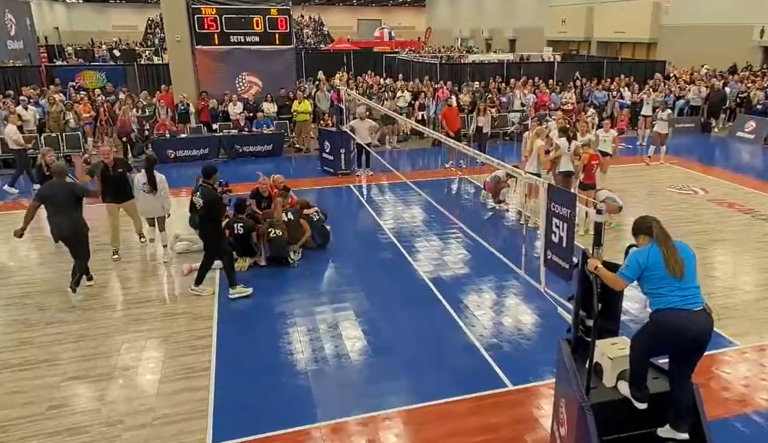
2026 USAV Girls Junior National Championship 16-17 Results
The 2026 USA Volleyball Girls Junior National Championship for divisions 14-17 wrapped…

10 Best Volleyball Training Apps Review 2026: A Comprehensive Guide for Volleyball Athletes
10 Best Volleyball Training Apps Review 2026: A Comprehensive Guide for Volleyball…
Free Mental Performance Toolkit
Get 5 science-backed exercises used by Olympic athletes. Delivered to your inbox.
No spam. Unsubscribe anytime.