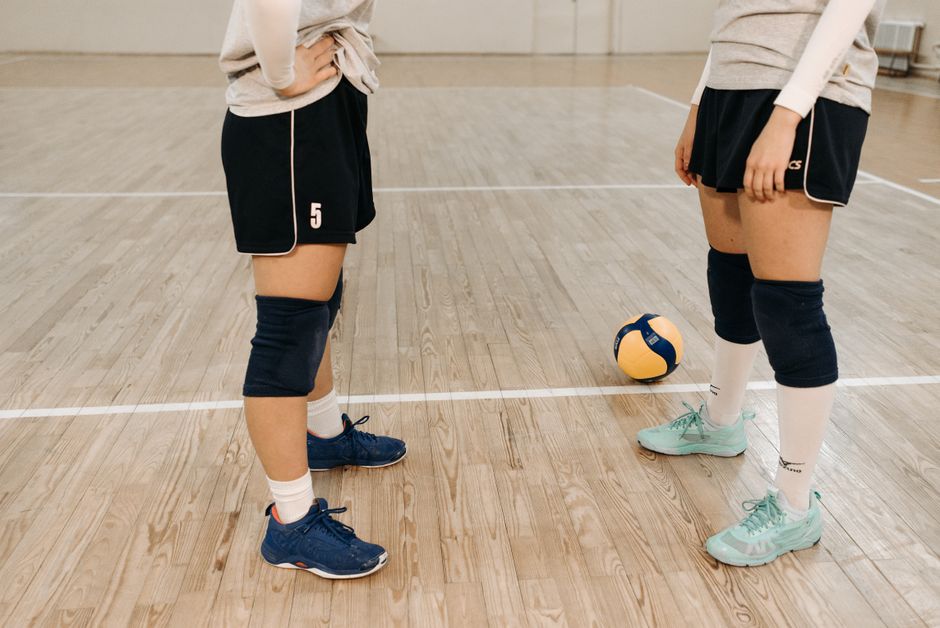
Every serve, every dig, every sprawl asks your shorts one question: will you move, or will you fight me on the way down?
Spandex answers by disappearing. The right pair moves like skin, stays put through a five-setter, and never pinches under knee pads. Here is how volleyball players actually pick spandex, including the honest version of what compression does, because the research says less than the marketing claims.
Why Do Volleyball Players Wear Spandex?
Three honest reasons: freedom, coverage, and no snags.
Freedom first. Defending a volleyball court means hips in every direction, sometimes with the floor involved. Loose shorts catch on knees, drag on the floor, and shift during digs. Spandex stays where you put it.
Coverage second. A close-fitting short stays put during a dive in ways loose gear does not, which is why it became the sport’s uniform standard. No current data suggests the fabric itself adds measurable in-game performance, but the movement case does not need it.
The compression angle needs honesty. A 2025 systematic review and large study of controlled trials found the evidence for compression garments enhancing performance is, in the authors’ words, inconclusive . A 2018 large study on lower-limb compression during high-intensity exercise found mixed effects on performance and physiology . Where compression shows better support is recovery: meta-analyses link compression garments to reduced muscle soreness and improved recovery from exercise-induced muscle damage . Translation: wear spandex for movement and comfort. If you feel a difference in recovery after tournament weekends, the research is on your side.
Which Type of Volleyball Spandex Is Right for You?
| Type | Coverage | Best for | Price tier |
|---|---|---|---|
| Classic compression spandex short | Minimal, snug | The uniform standard: maximum movement | Budget to mid |
| Longer compression short (7-9 inch) | More thigh | Players who want more coverage, no ride-up | Mid |
| Boy-short style with looser cut | Full seat | Players who dislike tight fit | Budget |
| Spandex with built-in ball pocket | Minimal | Beach and outdoor play | Mid |
| Layered: spandex under loose shorts | Full | Practice comfort, youth players | Budget to mid |
What Should You Look For in Volleyball Spandex?
- A wide, flat waistband. Narrow waistbands dig in during long seated bus rides and roll when you jump. Wide bands stay put.
- Leg grippers, not loose hems. The #1 ride-up fix is a silicone or elastic leg opening. Test in a full squat before buying.
- Flat or bonded seams. Seams across the inner thigh become chafe lines by match three. Run your thumb over every seam first.
- Four-way stretch, checked live. Stretch the fabric both directions in the store. Two-way stretch rolls and bags out.
- Waist sitting where you actually wear it. Sizing charts vary by brand. Order two sizes if between them, keep the one that stays put without digging.
Which Spandex Models Do Volleyball Players Use Most?
We cannot test products in a lab, so treat this as the shortlist you see in club gyms, then check current prices and recent reviews before buying.
- ASICS volleyball shorts. The volleyball-brand default with consistent sizing year over year.
- Nike Pro compression shorts. The multi-sport staple. Durable waistband and broad color range.
- Under Armour volleyball shorts. Compression-first fit with a slightly longer cut.
- Adidas club shorts. The budget route with frequent team-discount availability.
FAQ: Volleyball Spandex
Does compression spandex actually improve performance? The honest answer is no, not directly. Meta-analyses of compression garments find the performance evidence inconclusive, while recovery and soreness benefits are better supported .
How do I stop spandex from riding up? Fit first: correct size with leg grippers. Second: flat seams and four-way stretch fabrics. Third: longer cuts if grippers are not enough.
What length spandex do volleyball players wear? Uniform rules set the limits; within them, personal comfort rules. Classic cuts stay shortest; 7 to 9 inch cuts add coverage with the same movement.
Can you wear knee pads over spandex? Yes, that is the standard layering. Spandex under knee pads is the norm in indoor volleyball. The pad sleeve goes over the spandex smoothly.
Should youth players wear compression spandex? For movement and coverage, yes. For compression claims, the honest position is that the performance evidence is thin, and comfort should be the entire deciding factor .
Wear What Moves. Train What Matters.
Gear removes distractions. Confidence removes doubt. Take the free mental performance assessment and check where your game stands beyond the uniform.
—
Sources
- Wang W, et al. “Do compression garments enhance running performance? An updated systematic review and large study.” J Sport Health Sci, 2025. PMID 39842661. https://pubmed.ncbi.nlm.nih.gov/39842661/
- da Silva CA, et al. “Association of Lower Limb Compression Garments During High-Intensity Exercise with Performance and Physical Responses: A Systematic Review and Large study.” Sports Med, 2018. PMID 29721839. https://pubmed.ncbi.nlm.nih.gov/29721839/
- Hill J, et al. “Compression garments and recovery from exercise-induced muscle damage: a large study.” Br J Sports Med, 2014. PMID 23757486. https://pubmed.ncbi.nlm.nih.gov/23757486/
- Hagner-Derengowska M, et al. “Effects of post-exercise compression garments on subsequent endurance performance and delayed-onset muscle soreness in endurance athletes: a systematic review and large study.” Front Physiol, 2026. PMID 42602003. https://pubmed.ncbi.nlm.nih.gov/42602003/
Get 1 Mental Training Drill Every Week
Free. Unsubscribe anytime.
VBallStars.com
Mental Training for Volleyball
Published by VBallStars.com — founded by a former college athlete and volleyball dad who spent nearly a decade in the gyms, watching his daughter come up through top clubs from North Texas to Atlanta, GA, and noticed the mental side was the last thing coached, if at all. Read the full story →